Medical tourism
General Information
National Medical Research Center for Neurosurgery named after Academician N.N. Burdenko (founded in 1932) is the leading neurosurgical facility in Russia.
The Center is based on:
10 clinical departments for 300 beds
Neurointensive care unit for 38 beds
Operation theater for 22 rooms
The staff of 1486 health care professionals
16 professors
161 MD Ph.D.
The Center's staff are members of Russian and international societies:
World Federation of Neurosurgical Societies (WFNS)
European Association of Neurosurgical Societies (EANS)
Asian Congress of Neurological Surgeons (ACNS)
Euroacademia Multidicsiplinaria Neurotraumatologica (EMN)
Russian Association of Neurosurgeons (RAN)
Russian Association of Spinal Surgeons (RASS)
Annually at the National Center:
12 000 inpatients treated
10 000 neurosurgical operations performed
~3 000 radiosurgical procedures done
93 000 medical consultations provided
1 500 patients served at the day hospital
30 000 patients undergo CT, MRI, PET
Neuroimaging diagnostics:
5 MR scanners ( 1.5 T and 3.0T)
6 CT scanners ( incl. i/op. and ICU)
2 DSA
PET
A range of neurosurgical areas and a broad spectrum of pathology treated at the National Center for Neurosurgery is listed below.
Pediatric neurosurgery:
brain and spinal cord tumors, including differential craniopharyngioma treatment under the guidance of the Honorary President, MD, Ph.D., Professor, Academician of the Russian Academy of Sciences A.N. Konovalov (the world's largest series of over 4,000 observations);
malformations;
various types of hydrocephalus;
сraniofacial deformities;
epilepsy
Vascular neurosurgery (the founder of endovascular neurosurgery - Academician of the Russian Academy of Medical Sciences, Professor F.A. Serbinenko developed a technique for the surgical treatment of cerebrovascular diseases - endovascular occlusion, reconstructive vascular surgery, targeted superselective catheterization):
arterial aneurysms (microsurgical and endovascular operations for cerebral aneurysms and arteriovenous malformations (the world's largest number of observations (about 2000) of endovascular AVM and dural fistulas of the spinal cord occlusion);
arteriovenous malformations (removal of big and deeply located vascular malformations;
arterial anastomoses construction (extra-intracranial and wide-lumen);
cavernous malformations;
hemorrhagic stroke;
stenosis and extra- and intracranial vascular occlusion (reconstructive surgery of brachiocephalic vessels with their occlusion, etc.)
Neurooncology:
skull base tumors including acoustic neuromas, meningiomas and other lesions
skull base tumors with invasion into the orbit, cavernous sinus, anterior cranial fossa, middle cranial fossa, posterior cranial fossa;
intracerebral hemispheric tumors;
tumors of the ventricle,
pineal area tumors using minimally invasive approach technology (key-hole and burr-hole surgery),
brainstem tumor;
colloid cysts;
cavernomas and hematomas (also involving brainstem);
epidermoid and dermoid cysts;
pineal cysts;
gliomas (astrocytoma, oligodendroglioma, oligoastrocytoma, glioblastoma);
lymphomas;
chordomas;
pituitary adenomas (over 5000 observations of endoscopic transnasal removal of pituitary adenomas);
craniopharyngiomas;
cerebellar tumors;
cystic brain neoplasms;
common craniofacial angiofibromas;
metastatic tumors.
Functional neurosurgery:
neurosurgical treatment of extrapyramidal disorders (Parkinson's disease, dystonia, various types of tremors and hyperkinesis)
neurosurgical treatment of chronic non-oncological pain syndromes (chronic head and facial pain, neuritis, neuralgia, neuropathy of extremities, Complex regional pain syndrome (CRPS) of both types, pain syndromes followed by limb amputation, tunnel pain syndromes, pain syndromes after spinal surgery, facet pain syndrome, pain after chest and mammary gland surgery, postherpetic neuralgia, ischemic pain in the upper and lower extremities and angina pectoris when revascularizing operations are impossible)
neurosurgical treatment of oncological pain syndromes.
surgical treatment of spastic syndromes as a result of spinal cord and craniocerebral trauma, neurodegenerative diseases
surgical treatment of various forms of infantile cerebral palsy
surgical treatment of obstetric paralysis
surgical treatment of diseases and injuries of the peripheral nervous system
surgical treatment of neurogenic disorders of the pelvic organs (myelodysplasia, consequences of spinal cord injuries)
surgical treatment of psychiatric diseases (Tourette's syndrome, obsessive-copulsive disorders, depression)
surgical treatment of epilepsy
Neurotrauma:
acute (including severe) traumatic brain injury with invasive monitoring of intracranial pressure followed by specialized neurosurgical care (decompressive cranioectomy, intracranial hematomas, depressed fractures removal);
the consequences of craniocerebral trauma and decompressive trepanation in relation to hemorrhagic strokes: bone defects of the cranial vault, including those involving the orbit, stereolithographic modeling techniques.
hydrocephalus (post-traumatic, occlusive, normotensive) using a step-by-step personalized diagnostic algorithm, the TAP test, individual selection of shunt systems
purulent-inflammatory diseases of the skull bones and brain (abscesses, empyema, osteomyelitis)
basal cerebrospinal fluid leaks (posttraumatic and spontaneous) with endoscopic and microsurgical interventions.
Spinal neurosurgery
spinal cord and spine tumors (intramedullary, extramedullary, intradural, extradural, paravertebral tumors, hourglass tumors)
degenerative diseases (herniated intervertebral discs, spinal stenosis, spondylolisthesis)
spine and spinal cord injuries
malformations
tumors and trauma of the peripheral nervous system
The Center’s infrastructure also includes the essential units:
radiotherapy department (5 units)
department of otorhinolaryngology
department of neuroophthalmology
department of psychiatry
department of neurorehabilitation
outpatient department
clinical diagnostic laboratory
department of clinical and industrial transfusiology
pathology department (reference center for pathomorphological and immunohistochemical diagnostics of CNS tumors)
Intraoperative technologies:
2 intraoperative CT (Siemens 256-slice CT-scanner and cone-beam intraoperative CT-scanner «O-arm» Medtronic)
intraoperative MRI
Awake surgery
digital subtraction angiography device
neuroendoscopy
navigation technologies
intraoperative neurophysiological monitoring
laser fluorospectroscopy
computer modeling and laser stereolithography
robot-assisted neurosurgery
neuromodulation
The Center is proud of its own:
Scientific and educational center (simulation center)
Conference hall (520 seats), which has hosted more than 100 conferences, including European Association of Neurosurgical Societies and World Federation of Neurosurgical congresses.
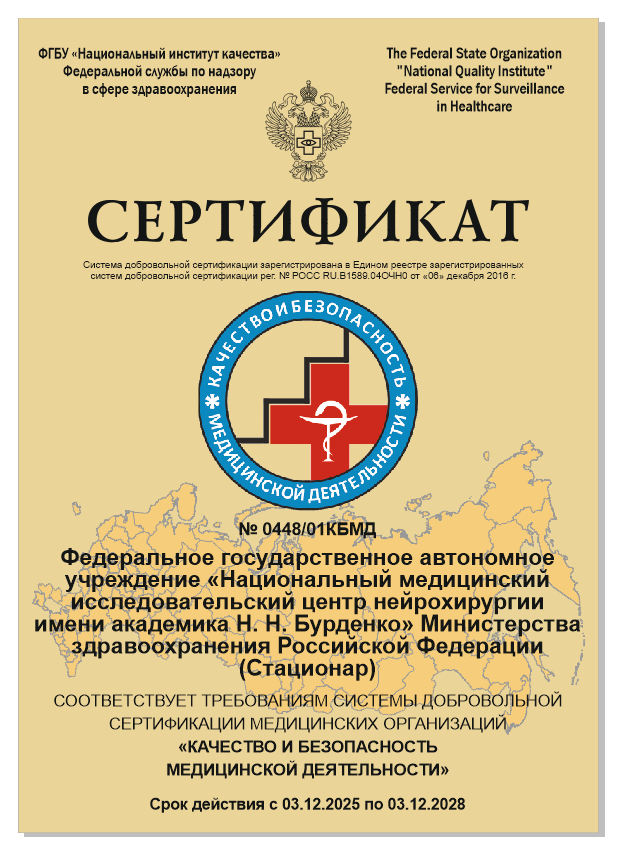
National Medical Research Center for Neurosurgery named after academician N.N. Burdenko is accredited under the program of the National Institute for Quality in 2019 (certificate №0034/01КБМД, valid 25.12.2019 - 25.12.2022)